Tuesday, 10 June 2014

The Archer/Bowman/Ranger

I wanted to have at least one specialist ranged character. The idea was to have a hooded figure with some sort of mask beneath. I started modelling with one mask, and then changed the mask on the model and the artwork at a later stage.

The artwork for the ranger after the mask was changed.
Turnaround for the ranger with the original mask.
The initial low poly.
The first stage of upscaling the model.
The model having been further upscaled in Maya.
The completed upscaled Maya model. 
The model being rigged, weighted and posed. The old mask had also been deleted to make way for the new one.
The completed Maya model of the archer including all props and the new mask.
A closeup of the new mask.
The model having been taken into ZBrush to upscale further. On the left, divisions have been added before smoothing. The right smoothed straight from the rigged model. Ready for printing.

Tuesday, 13 May 2014

The Medieval Crusader

For my second character, I wanted something similar to a knight but was lighter armoured and lighter on their feet. I also wanted to keep the character's face covered, to make them more androgynous.

Artwork for the crusader.
The crusader's turnaround.
The initial low poly model.
Adding more tris and smoothing the model as I go.
The model has been further upscaled, and is almost ready for UV mapping, rigging and weighting.
The model has been rigged, weighted and posed. 
The model has had all its props added, but will still need to be upscaled further before I can go to print.
A base is added, and the model has been taken into ZBrush. Extra divisions were added without smoothing the model. The model was then smoothed after so that the model maintained its shape. Now the model's ready for print.

Tuesday, 29 April 2014

The Medieval Walking Tank


I started 3D modelling the first character for my miniatures board game that I started creating back in January. I wanted all the characters to be in a Clone Wars/Team Fortress 2 visual style, and I started with my tank character, a female knight.

Artwork for the knight.
The model's initial turnaround featuring the character's robust yet feminine proportions beneath the armour.

Although I intend this tanking knight to be female, I decided against showing any of the characters' faces in the designs so that the models would be androgynous enough to encourage players of any gender to pick their favourite to personalise.

The initial 282-tri low poly model.

Smoothing the model manually in Maya to try and maintain the desired visual style.

Altered to a T-pose for easier rigging and weight painting later on. Hands added, and the fingers are kept square-ish to maintain that cartoony visual style.

Additional armoured added. Being a model for print, as much detail as possible must be modelled, can't rely on textures.

All armour and main details modelled. Any further details will be added when the model is upscaled in Mudbox or ZBrush.

The model seen from behind.

Its current poly count is fairly average for most modern digital game characters, but it still needs to be UV mapped and rigged. Once it's rigged, it'll be posed and imported to either Mudbox or ZBrush (neither program I'm vastly familiar with yet) so it's smoothness can be improved for the print model.

I'll likely end up reusing the UV mapped 15k model for promotional artwork, adding a texture reminiscent of the Borderlands art style.

For now, I'm concentrating on getting all the models up to at least this standard as quickly as possible before moving to the next stage, which would be posing and smoothing in Mudbox or ZBrush. The remaining characters are the duelist, the archer and the grenadier. Not to mention the monster itself.

Tuesday, 11 March 2014

Choosing the Setting: Fantasy

With the rise in popularity of the dark fantasy genre, largely due to the titanic success of HBO's (Home Box Office Entertainment's) adaptation of George R. R. Martin's A Song of Ice and Fire novel series, I thought I'd try experimenting with another visual theme for my game.

I started by drawing influences from other game series like Dragon Age and Dark Souls, but then started looking at actual medieval knight's armour for reference.

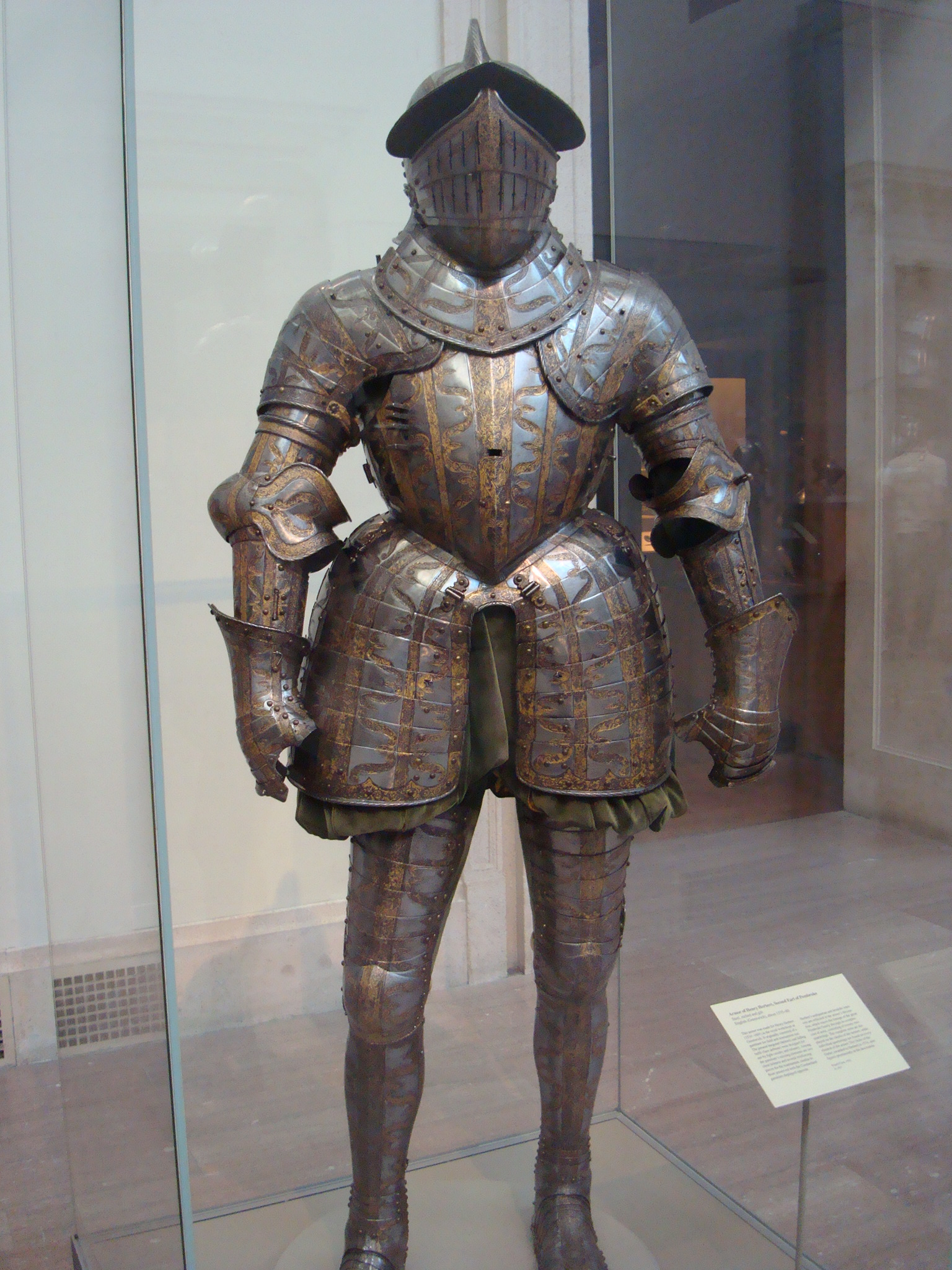
These are just some of the sketches I've done so far. The variety of real medieval armour is pretty surprising, from helmets to the styles of plate and chain mail. I think I need to explore this a lot more. Real medieval plate armour is also very non-gender-specific, this may present a great way of including some androgyny into masked characters.

Here are some cool medieval armour styles:

Image source: http://farm4.staticflickr.com/3341/3326748507_eb44d597a0_o.jpg
Last accessed: 14th April 2014
Image source: http://milleonaria.files.wordpress.com/2011/05/3326747977_139f21f27d.jpg
Last accessed: 14th April 2014
Image source: http://www.ageofarmour.com/images/sigfront.jpg
Last accessed: 14th April 2014
Image source: http://organicarmor.com/wp-content/uploads/2010/07/armor-met.jpg
Last accessed: 14th April 2014
Image source: http://en.academic.ru/pictures/enwiki/75/KHM_Wien_S_XIII_-_Jousting_armour_by_Jörg_and_Lorenz_Helmschmid_front.jpg
Last accessed: 14th April 2014

Tuesday, 25 February 2014

Choosing the Setting: Science Fiction


With the basic mechanics dealt with, the setting for the board game is pretty much interchangeable. With the inspiration for the game coming from survival horror games of the 90’s, my main idea for the game’s visuals would either be based on modern day slasher movies, or low tech science fiction, inspired by films like 2001: A Space Odyssey, Alien and Event Horizon.

I decided on the latter, and set about doodling some character designs.


The strongest silhouette out of my characters was the astronaut. However, with my stylistic preference, it's not as easy to give off the horror vibe. More to the point, it's really hard for a board game to be scary in the sense that a horror film or video game. Not only that but there hasn't really been a successful alien creature in horror since H. R. Geiger's creature in Alien.

Also, each character model has to be unique but also cool enough for people to want to buy it or collect the miniatures. It might be a good idea to try some other genres before committing to a theme. To try and find one that has the broadest appeal or one that's currently popular.

Tuesday, 11 February 2014

The Second Test


In the second test, there was a total of five players, and I sat out of this one. Again, no character players wanted to risk taking on the monster without a weapon. Until they were armed, it was largely a slow game of cat and mouse. Once the human characters had weapons, however, the game soon changed.

One of the human characters was killed early on in the game by the monster player, and the other three spent their time exploring while evading the monster until they felt well enough equipped to take on the monster. Once they got hold of weapons, they seemed to feel much more confident in fighting the monster, which is what I wanted. I wanted the players to recognise the monster as a threat, and try to arm themselves enough to take that risk.

Even after the exit tile was placed, the three remaining players refused to leave. Instead, taking up the challenge of killing the monster. After different methods of hit and run, two more players were killed by the monster, but not before weakening it. In the end, the monster player won by killing all four human characters.

Overall, all five players enjoyed the game and wanted to play it again. The following changes were suggested:

1. Giving the monster back its Hit stat, and adding a defensive stat so monsters and players had two rolls each in combat.
2. Increasing the monster’s movement from d6 to 2d6.
3. Increasing the monster’s damage from 1 to 1d3 (d6 divided by 2, and rounded to the nearest whole number).
4. Giving the monster the ability to push players back instead of getting extra attacks.
5. The monster player can place tiles too, to hinder the human players.
6. With an added defensive value, the monster’s health is reduced from 30 to 20.
7. The exit now requires a key to escape.

Tuesday, 4 February 2014

The First Test


I tested out the first set of rules with 4 players, and myself as the monster. Players grasped the rules fairly quickly, and explored the player generated map. They avoided the monster to begin with, but separated and spread out to explore. As the monster, it was difficult to catch other players when moving at the same speed. They spread out a lot, and I was forced to go after them one at a time in order create any sort of peril. This made the monster less intimidating.

For this game, the exit tile was placed in the middle of the tile deck. Once it was drawn and placed by a human player, 3 out of 4 players exited immediately. The fourth player, who had found the weapons, ammo, and healing items, decided to take on the monster.

This in when the first issue really arose, the only had to succeed one die roll to inflict damage on the monster, and the damage was miniscule. However, the monster had to pass 2 dice rolls in order to harm the player, which was two chances to fail. The damage that each player was inflicted was tiny, and needed to be increased. Not to mention that the dice rolls needed to be modified to make the likelihood of inflicting damage more even for both the monster player, and the human player. A very long and drawn out one on one fight between player 4 and the monster went on, before they eventually ran from the monster and exited.

Overall, the monster didn’t seem all that intimidating to the four other players. One player, Natasha Bristoe said, “I didn’t feel like the monster was a threat. It needed to be faster and tougher.” She also commented on the length of the game, believing that the exit tile tile was placed too soon, “I think it came up too early in our game.” On the plus side, she enjoyed each character having their own special rules, “I like that each character has their bonuses and drawbacks, it’s nice.” The main information to take away from this feedback is that the monster needs to be an increased threat, and the exit tile should be saved until later, to lengthen the game.

Another player, Thomas Moulton, felt the map was limited by how the map tiles could be combined, “The map tiles can’t go together in a lot of ways, mainly that rooms can’t connect to the pathways. The system felt limited.” This wasn’t a major issue in the game played, but it’s something that can be easily addressed at another time by redesigning the tiles. He also felt that neither the human characters or the monster were very damaging, that humans felt weak, and the monster didn’t feel threatening, “I would make the damage possible by the people with guns higher, and the monster’s hits more brutal.” Again, the damage both the human and monster can inflict needs to be addressed to make the monster more of a threat, or to make having a weapon feel more worthwhile.

For the second test, I made the following alterations:

1. The monster, for now, hits automatically when in base contact of the human player.
2. The monster gets an extra attack for each remaining space not moved.
3. The exit it tile is saved until last, and placed by the monster player when all other tiles are placed.