Tuesday, 29 April 2014

The Medieval Walking Tank


I started 3D modelling the first character for my miniatures board game that I started creating back in January. I wanted all the characters to be in a Clone Wars/Team Fortress 2 visual style, and I started with my tank character, a female knight.

Artwork for the knight.
The model's initial turnaround featuring the character's robust yet feminine proportions beneath the armour.

Although I intend this tanking knight to be female, I decided against showing any of the characters' faces in the designs so that the models would be androgynous enough to encourage players of any gender to pick their favourite to personalise.

The initial 282-tri low poly model.

Smoothing the model manually in Maya to try and maintain the desired visual style.

Altered to a T-pose for easier rigging and weight painting later on. Hands added, and the fingers are kept square-ish to maintain that cartoony visual style.

Additional armoured added. Being a model for print, as much detail as possible must be modelled, can't rely on textures.

All armour and main details modelled. Any further details will be added when the model is upscaled in Mudbox or ZBrush.

The model seen from behind.

Its current poly count is fairly average for most modern digital game characters, but it still needs to be UV mapped and rigged. Once it's rigged, it'll be posed and imported to either Mudbox or ZBrush (neither program I'm vastly familiar with yet) so it's smoothness can be improved for the print model.

I'll likely end up reusing the UV mapped 15k model for promotional artwork, adding a texture reminiscent of the Borderlands art style.

For now, I'm concentrating on getting all the models up to at least this standard as quickly as possible before moving to the next stage, which would be posing and smoothing in Mudbox or ZBrush. The remaining characters are the duelist, the archer and the grenadier. Not to mention the monster itself.

Tuesday, 11 March 2014

Choosing the Setting: Fantasy

With the rise in popularity of the dark fantasy genre, largely due to the titanic success of HBO's (Home Box Office Entertainment's) adaptation of George R. R. Martin's A Song of Ice and Fire novel series, I thought I'd try experimenting with another visual theme for my game.

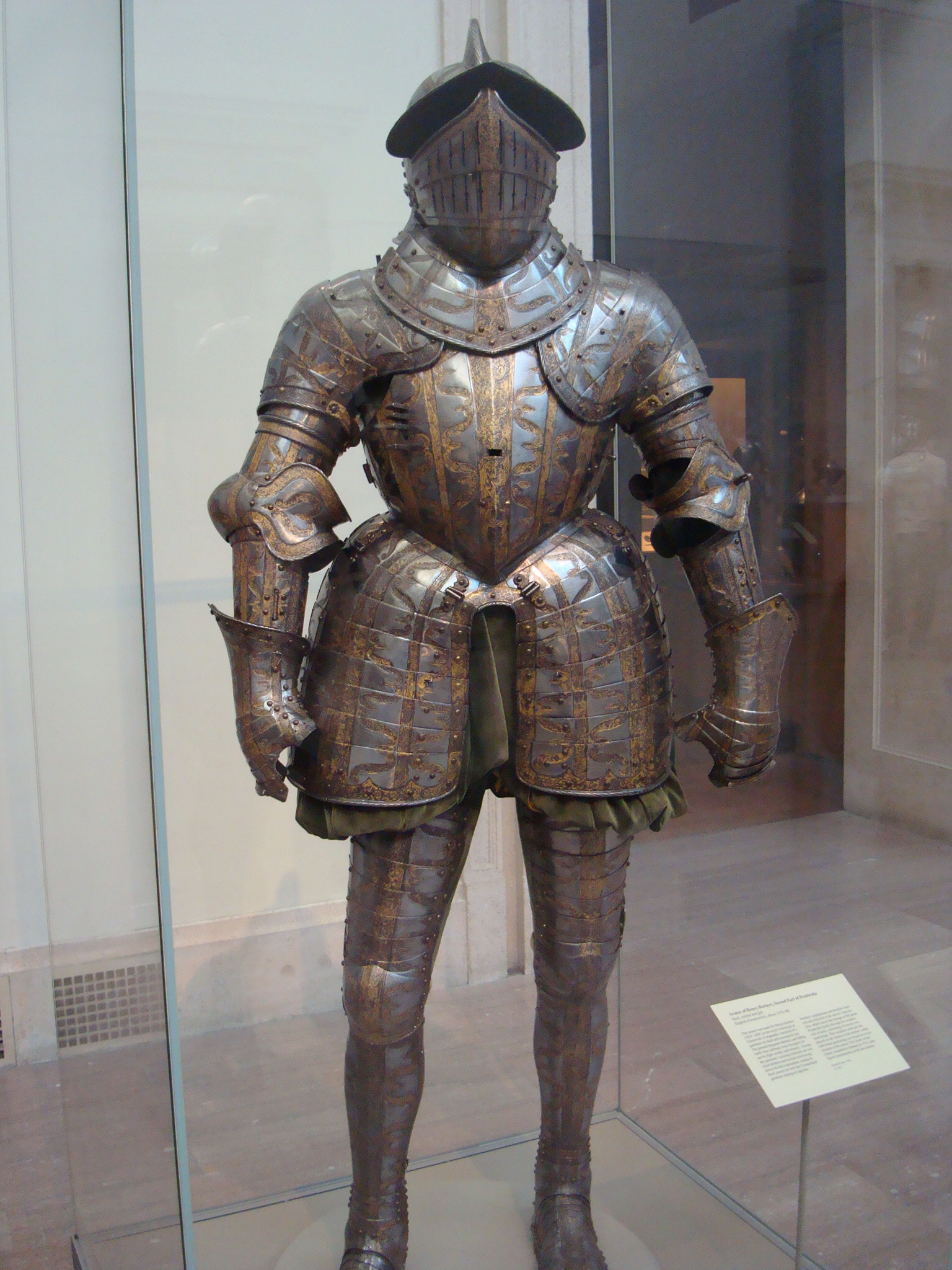
I started by drawing influences from other game series like Dragon Age and Dark Souls, but then started looking at actual medieval knight's armour for reference.

These are just some of the sketches I've done so far. The variety of real medieval armour is pretty surprising, from helmets to the styles of plate and chain mail. I think I need to explore this a lot more. Real medieval plate armour is also very non-gender-specific, this may present a great way of including some androgyny into masked characters.

Here are some cool medieval armour styles:

Image source: http://farm4.staticflickr.com/3341/3326748507_eb44d597a0_o.jpg
Last accessed: 14th April 2014
Image source: http://milleonaria.files.wordpress.com/2011/05/3326747977_139f21f27d.jpg
Last accessed: 14th April 2014
Image source: http://www.ageofarmour.com/images/sigfront.jpg
Last accessed: 14th April 2014
Image source: http://organicarmor.com/wp-content/uploads/2010/07/armor-met.jpg
Last accessed: 14th April 2014
Image source: http://en.academic.ru/pictures/enwiki/75/KHM_Wien_S_XIII_-_Jousting_armour_by_Jörg_and_Lorenz_Helmschmid_front.jpg
Last accessed: 14th April 2014

Tuesday, 25 February 2014

Choosing the Setting: Science Fiction


With the basic mechanics dealt with, the setting for the board game is pretty much interchangeable. With the inspiration for the game coming from survival horror games of the 90’s, my main idea for the game’s visuals would either be based on modern day slasher movies, or low tech science fiction, inspired by films like 2001: A Space Odyssey, Alien and Event Horizon.

I decided on the latter, and set about doodling some character designs.


The strongest silhouette out of my characters was the astronaut. However, with my stylistic preference, it's not as easy to give off the horror vibe. More to the point, it's really hard for a board game to be scary in the sense that a horror film or video game. Not only that but there hasn't really been a successful alien creature in horror since H. R. Geiger's creature in Alien.

Also, each character model has to be unique but also cool enough for people to want to buy it or collect the miniatures. It might be a good idea to try some other genres before committing to a theme. To try and find one that has the broadest appeal or one that's currently popular.

Tuesday, 11 February 2014

The Second Test


In the second test, there was a total of five players, and I sat out of this one. Again, no character players wanted to risk taking on the monster without a weapon. Until they were armed, it was largely a slow game of cat and mouse. Once the human characters had weapons, however, the game soon changed.

One of the human characters was killed early on in the game by the monster player, and the other three spent their time exploring while evading the monster until they felt well enough equipped to take on the monster. Once they got hold of weapons, they seemed to feel much more confident in fighting the monster, which is what I wanted. I wanted the players to recognise the monster as a threat, and try to arm themselves enough to take that risk.

Even after the exit tile was placed, the three remaining players refused to leave. Instead, taking up the challenge of killing the monster. After different methods of hit and run, two more players were killed by the monster, but not before weakening it. In the end, the monster player won by killing all four human characters.

Overall, all five players enjoyed the game and wanted to play it again. The following changes were suggested:

1. Giving the monster back its Hit stat, and adding a defensive stat so monsters and players had two rolls each in combat.
2. Increasing the monster’s movement from d6 to 2d6.
3. Increasing the monster’s damage from 1 to 1d3 (d6 divided by 2, and rounded to the nearest whole number).
4. Giving the monster the ability to push players back instead of getting extra attacks.
5. The monster player can place tiles too, to hinder the human players.
6. With an added defensive value, the monster’s health is reduced from 30 to 20.
7. The exit now requires a key to escape.

Tuesday, 4 February 2014

The First Test


I tested out the first set of rules with 4 players, and myself as the monster. Players grasped the rules fairly quickly, and explored the player generated map. They avoided the monster to begin with, but separated and spread out to explore. As the monster, it was difficult to catch other players when moving at the same speed. They spread out a lot, and I was forced to go after them one at a time in order create any sort of peril. This made the monster less intimidating.

For this game, the exit tile was placed in the middle of the tile deck. Once it was drawn and placed by a human player, 3 out of 4 players exited immediately. The fourth player, who had found the weapons, ammo, and healing items, decided to take on the monster.

This in when the first issue really arose, the only had to succeed one die roll to inflict damage on the monster, and the damage was miniscule. However, the monster had to pass 2 dice rolls in order to harm the player, which was two chances to fail. The damage that each player was inflicted was tiny, and needed to be increased. Not to mention that the dice rolls needed to be modified to make the likelihood of inflicting damage more even for both the monster player, and the human player. A very long and drawn out one on one fight between player 4 and the monster went on, before they eventually ran from the monster and exited.

Overall, the monster didn’t seem all that intimidating to the four other players. One player, Natasha Bristoe said, “I didn’t feel like the monster was a threat. It needed to be faster and tougher.” She also commented on the length of the game, believing that the exit tile tile was placed too soon, “I think it came up too early in our game.” On the plus side, she enjoyed each character having their own special rules, “I like that each character has their bonuses and drawbacks, it’s nice.” The main information to take away from this feedback is that the monster needs to be an increased threat, and the exit tile should be saved until later, to lengthen the game.

Another player, Thomas Moulton, felt the map was limited by how the map tiles could be combined, “The map tiles can’t go together in a lot of ways, mainly that rooms can’t connect to the pathways. The system felt limited.” This wasn’t a major issue in the game played, but it’s something that can be easily addressed at another time by redesigning the tiles. He also felt that neither the human characters or the monster were very damaging, that humans felt weak, and the monster didn’t feel threatening, “I would make the damage possible by the people with guns higher, and the monster’s hits more brutal.” Again, the damage both the human and monster can inflict needs to be addressed to make the monster more of a threat, or to make having a weapon feel more worthwhile.

For the second test, I made the following alterations:

1. The monster, for now, hits automatically when in base contact of the human player.
2. The monster gets an extra attack for each remaining space not moved.
3. The exit it tile is saved until last, and placed by the monster player when all other tiles are placed.

Tuesday, 28 January 2014

A Game of Miniatures

Since the start of December 2013, I’d been thinking about creating a game based around having 3D models of characters. Naturally, my first step was to look into analogue games that used miniatures. The ones I’m most familiar with are games like D&D (Dungeons and Dragons), and Game Workshop’s tabletop war games, Warhammer and Warhammer 40,000.

Warhammer, a fantasy war game created by Games Workshop
Image source: http://images.rtsguru.com/articles/images/5000/4688/warhammer-fantasy-battle.jpg
Last accessed: 14th April 2014
Warhammer 40,000, a gothic science fiction war game by Games Workshop
Image source: http://www.chrisshipton.co.uk/Spacehulk/spacehulk-02.jpg
Last accessed: 14th April 2014


In an adventurer’s turn, the player takes one tile from a pile, and adds it to the map connecting a corridor to a corridor or a room to a room. Rooms are blocked by doorways, open doorways are green, locked doorways and red. Players must find a key to open red doors. Human players must place a tile at the beginning of their turn until all tiles have been placed. The exit tile should be placed in the middle of a shuffled deck of tiles or placed at the bottom of the pile, depending on how long players wish to play.

All of these games have a collection of rulebooks that teach players how to play the games with miniatures and scenery, peripherals, that are sold separately in order to play the games properly. Players take a lot of pride in customising their characters in D&D or their armies in Warhammer, so making a miniatures based bored game is a fantastic way to monopolies on merchandise, providing I can hit the right market.

My first attempt at creating a miniatures game was overly complex, I spent a couple weeks coming up with complex rules for a post-apocalyptic tabletop RPG (role playing game) that relied on calculating percentages by using 2d10 (a pair of 10-sided dice). However, it soon occurred to me that creating such a complex and ambitious board game might be a bit too ambitious to attempt within a 9-month time frame.

Not to mention that these games with their intricate 500-page rulebooks can actually be very off-putting for new players. Even I have trouble remembering all the rules for games like Warhammer 40,000, and forgetting the rules can sometimes stop a game dead or blind you to cheaters. It can ruin your game experience remembering so much, unless that’s your niche, and you enjoy complex games. Not to mention that, unless you’re a D&D player or someone who plays a lot of pen and paper RPGs, such as World of Darkness, you’re unlikely to know what a d10 is, let alone where to get some. It suddenly became very paramount that I try to make the game as accessible as possible so that even new players wouldn’t be put off playing it.

I wanted something that was character based with collectible miniatures, and easy to pick up, that didn’t have a long rulebook to read. Instead I settled for something small scale dungeon-style game with chance involved in its core mechanic. To start with, I designed a board game that used character miniatures, a board made up of tiles, cards, and a single d6 (a 6-sided die).

The game itself, for now, is for 2 to 5 players that pits 1 to 4 adventurers or survivors against a difficult monster. Players create a unique map by placing 4-inch by 4-inch tiles together. They can explore rooms to gain keys and items that may help the adventurers survive until they either escape the maze or kill the monster. The monster’s goal is to wipe out the other players before they can leave. The idea was inspired by slasher films and 90s survival horror games.

Rules - How To Play (ver. 1)

The home tile is placed in the middle of the table. Up to 4 adventurers are placed in the centre of the tile. The adventurer players each roll a d6 (6-sided die), highest goes first followed by the player on their left, etc (going clockwise). If there are 2 high rollers, they roll of until there’s a winner.

Each room has a card count written on the tile, the cards are placed in the room face down, and flipped when a player enters. Item cards can contain weapons, consumables or keys. A player can carry a maximum of 6 items in their “inventory” or hand. A player does not have to pick up the item if they don’t want it. Items are shuffled back in the item card pile when used and discarded. Players can trade items with other players on the same tile, or drop item cards on the tile if they’re undesired. Monsters can’t pick up or use items.

Once a player has placed a tile, they roll a d6 and can move that many spaces. A player can pass other characters’ spaces, but can’t land on the same space as another player or the monster. If the player moves through spaces occupied by the monster, the monster gets 1 free attack. When all adventurers have had their first turn, the end of the first round, the monster is placed in the centre of the home tile, but does not move yet. This is to give the weaker adventurers time to move away and potential arm up before the chase starts.

The monster always goes last in turn order, and doesn’t get their first movement until the end of the second round. When the last adventurer has had their second turn by placing a tile and moving, the monster player can then roll a d6 to move. The monster can’t enter a room unless the doorway is two spaces wide, but they can attack through walls if they are in base contact with an adventurer. If a player is in combat range, then can either move or attack, they can’t do both. However, the monster can’t pass through or land on the space of a human player, and must stop their movement when in base contact to attack. Only the monster can move and attack.

An adventurer can’t attack unless they have a weapon card, but the monster can always attack. The adventurers have 5 attributes each, HP (hit points), Hit, Aim, Dodge and Hide. HP determines how much damage a character can take before dying. Hit is your character’s accuracy with a melee weapon. Aim is the character’s accuracy with a ranged weapon. Dodge is the character’s ability to evade enemy attacks. Hide is the character’s ability to remain undetected. Hide is only applicable when inside a room, if successful, it makes your character immune to damage if a monster attacks through a wall, but the player misses their next turn. The monster in the initial game only has HP and Hit, with an additional Damage stat. Player characters and monsters can also have special rules that affect the game in different ways.

Basic HP for an adventurer is 3, meaning that a player can take 3 direct hits from a monster before dying. The other stats are shown on player cards in the form of die rolls. For example, if a PC’s (player character’s) Aim is 3+, you must roll a 3 and above on a d6 to hit with a ranged weapon. Rolling a 1 is always a failure. When a PC’s HP reaches 0, they are out of the game unless revived by another player. “Dead” PCs can only be revived by other players in base contact using a healing item.

The game ends when all characters have escaped or died, or the monster has been defeated.

The character card descriptions and tile examples are as follows:

Character 1
3HP
Hit 5+
Aim 5+
Dodge 3+
Hide 3+.

Special Rules:
It’s Over There!
Players on the same tile get +1 to Aim.

Mine!
Must pick up every item found.

Coward!
When hiding, forfeit 2 turns instead of 1.

Character 2
3HP
Hit 3+
Aim 3+
Dodge 5+
Hide 5+

Special Rules:
Come Get Me!
Players on the same tile get +1 to Hide.

Die Already!
Must attack twice before leaving combat.

Lone Wolf
Cannot trade items.

Character 3
3HP
Hit 5+
Aim 3+
Dodge 5+
Hide 3+

Special Rules:
Look Out!
Players on the same tile get +1 to Dodge.

Ah-ha!
When hiding, roll a d6. On a 4+, draw an item card.

Grudge
Only helps friendly players.

Character 4
3HP
Hit 3+
Aim 5+
Dodge 3+
Hide 5+

Special Rules:
Don’t Be A Wuss!
All players on the same tile get +1 to Hit.

Ew, No!
Cannot pick up dropped items.

Shallow
Ignore the player on your left.

Monster
30HP
Hit 4+
Deal 1HP damage for a successful hit that’s not dodged.

Item Cards (21)
1x Knife - melee weapon (base contact), uses Hit stat, deals 1HP damage, unlimited uses.
1x Pipe - melee weapon (base contact), uses Hit stat, deals 2HP damage, unlimited uses.
1x Handgun - ranged weapon (10 spaces), uses Aim stat, deals 1HP damage, 7 uses.
1x Shotgun - ranged weapon (5 spaces, 3 spread), uses Aim stat, deals 2HP damage, 6 uses.
4x Handgun Clips - when used and discarded, increases handgun uses by 7.
2x Shotgun Shells - when used and discarded, increases shotgun uses by 6.
2x Bandages - when used and discarded, increases HP by 1.
2x First Aid Kits - when used and discarded, increases HP by 3.
5x Keys - unlocks locked doors.
1x Flashlight - +2 to aim.
1x Backpack - character upgrade, increases inventory by 2. Doesn’t count as an item.

Tiles (30)
1x Home (crossroad)
1x Exit (t-junction)
2x Straight corridor with 2 rooms
4x Straight corridor
5x Dead end with locked room
3x T-junction with room
4x T-junction
2x Corner with 2 rooms
4x Corner
4x Crossroad

Tuesday, 26 November 2013

Retrospective


When I went into this MA, I wasn’t entirely sure what direction I wanted to go in. I knew I wanted to focus on video game characters at least, and improving my 3D skills when it came to translating my 2D art into 3D characters. I knew what inspired me as an artist and I wanted to figure out how I could incorporate my inspirations into the characters I designed.

A lot of my influences came from animation and comic books, so I wanted to try and bridge the gap, visually, between those and games.

I started by looking at some video games that already have visual aesthetics similar to the comics that I drew my own influences from. Gearbox’s Borderlands series had some really unique visuals that reminded me of the artwork of comic book artist John Romita Jr.

Borderlands by 2K Games
Image source: http://nightmaremode.net/wp-content/uploads/2012/02/borderlands3.jpg
Last accessed 9th December 2013

Kick Ass 2 by Mark Miller and John Romita Jr.
Image source: http://imgs.abduzeedo.com/files/articles/john_romita_jr/2ph.jpg
Last accessed: 9th December 2013

However, beyond the unique textures, there wasn’t much else that emulated comic book art within the game.

I also looked at redesigning classic characters by putting a new spin on the series. This culminated in a few redesigns of the Seven Dwarves from Snow White as space miners.


I even got in so far as to attempt modelling one of the dwarves.


I loved the chunkiness and shape of cartoonish characters when modelled in 3D, and realised that it’s not often that you see a clear transition from a game’s 2D art to its 3D aesthetics.

I wondered why, if anything, most games today tend to stray from stylised aesthetics and favour a more realistic approach other than just the jump in technology.

In my literature and contextual review, I explored the ongoing debate of aesthetics versus graphics and whether or not it had an effect on how immersive that game was to the player.

Through my literature review, I determined that neither graphics or aesthetics alone determined how immersive a game was. In fact, it seemed as though it did not matter how stylised or realistic a game was, as long as it had a unified visual aesthetic, and suspended the player’s disbelief, the characters and world would be immersive either way.

In my contextual review, I determined that, as impressive as technology and graphics have gotten, it was much easier to determine a character’s role and determine the expressiveness of a character in a game with a strong stylised aesthetic. This was also backed up later on by my personal research studies and speaking with industry professionals in my practitioner study report.

Learning that immersion wasn’t affected specifically by either aesthetics or graphics kind of gave me the freedom to focus on stylised characters. I knew that just because a character might look cartoony, it didn’t mean that the character would be less believable or that an audience would be less involved with that character.


By this stage I was still figuring out what direction I wanted to go in but I was starting to narrow my focus. I was looking into the best way to present any 3D characters I designed and modelled, and the best idea that came to my mind involved merchandised 3D statues. Like those from Gentle Giant Ltd and Electric Tiki Design.

Boba Fett by Gentle Giant Ltd.
Image source: http://ryanlb.com/images/starwars/images/boba-fett-animated-maquette-2.jpg
Last accessed: 9th December 2013
Nightmare of Elm Street's Freddy Krueger by Gentle Giant Ltd.
Image source: http://media.archonia.com/images/samples/23/63/62363_s0.jpg
Last accessed: 9th December 2013

These heavily stylised statues, based on characters from popular television and movie franchises, had spades of character, not only in their actual design, but in the character’s gesture and implied movement. I knew from the moment I spotted these that this would be a fantastic way to present any future characters.

I also, briefly, touched on character driven narratives. The classic hero’s journey often follows a character’s progression from zero to hero or puts the character through a grueling quest that has the character learn, grow and develop over the course of the story, for better or worse.

It started to dawn on me that there’s much more to characters in games than simply their design. The design is just the first impression.

A character is as much about their personality and development as they are made to fit within a role within an established world. I thought about how interesting it would be to see a character break out of a perceived role.

I got to a point where I started to focus more and more on trying to translate 2D visual styles into 3D. I have a strong 2D art style myself and I thought it would be interesting to see how that would work in 3D, if at all. I took one of the 2D characters I designed early in practise 1 and modelled it in 3D.


This helped me better understand how to get 3D characters to emulate a 2D visual style without losing those hard edges or complicating the silhouette. Thanks to this, I wanted to see, or have, games that pushed their aesthetic style to those that emulated traditional 2D animation while actually being in 3D. Almost like having a playable cartoon or comic book.

It was at this stage that I was given the chance to play around with motion capture. It was a fantastic opportunity but, unfortunately, I had no previous experience in rigging or animating 3D characters. It was a process I had to learn from scratch and, in doing so, I’ve yet to really see my characters animated yet. It took me roughly 4 months to learn how to rig, weight and import my character into the necessary programs.

As this is a game’s design course, I started to think about how I could communicate this idea of translating 2D art styles into 3D, as well as character driven narratives into a game idea that didn’t require a programmer or, necessarily, a team to pull off. One that also incorporated the merchandising of 3D sculptures or models. This idea was an analog tabletop game involving figures or miniatures. This is what I will work on for the remainder of my second practise and bring into practise 3.